
Wood Veneer vs Solid Wood: A Hotel Furniture Buyer’s Guide
Compare veneer and solid wood for hotel furniture, then check construction, indoor conditions, surface evidence, care and replacement details before approval.
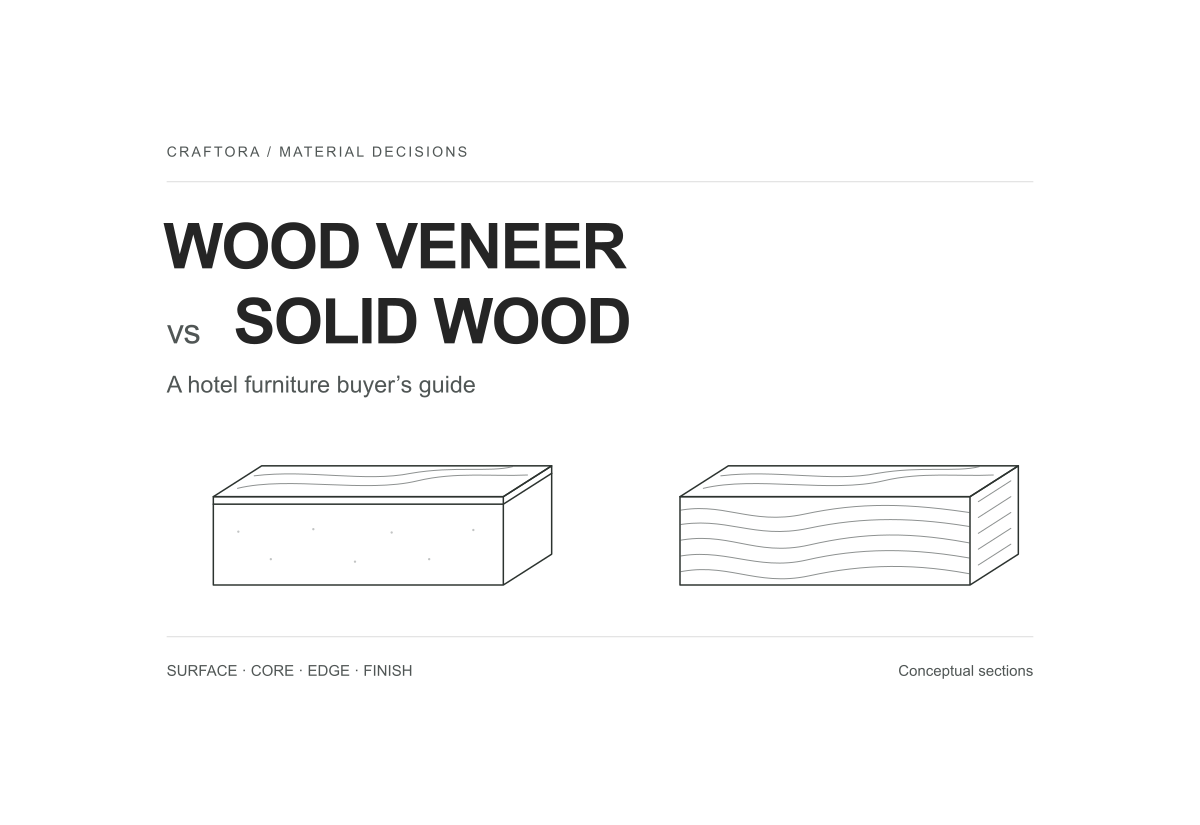
Wood veneer and solid wood can both belong in a well-specified hotel furniture package. The useful question is not which label sounds more premium. It is which construction suits each component, how its appearance will be approved, and what the hotel can do if that component is damaged.
For an interior designer or project buyer selecting desks, bedside units, headboards and wardrobes, this guide compares the decisions behind the material names. Start by separating four things: the visible surface, the core, the edge and the finish. A description such as “oak finish” does not settle any of them.
The short answer for project buyers
- Wood veneer is real wood in a thin layer, typically applied to a specified substrate. It is not the same as a printed woodgrain surface.
- Solid wood describes the timber section of a component. Confirm which parts are solid wood; do not assume the label describes every part of a cabinet or table.
- A mixed construction is not a contradiction. A veneered panel and a solid-wood edge can appear in the same item. Evaluate the complete specification rather than ranking the labels.
1. Compare the construction, not just the finish name
The Decorative Hardwoods Association describes veneer as a thin sheet of wood. In a furniture specification, the veneer species and appearance still need to be distinguished from the material underneath it.
| Decision | Veneer-faced component | Solid-wood component |
|---|---|---|
| What is supplied? | Identify the wood face, core material, total panel thickness and edge treatment. | Identify the species, timber sections, joints and any other materials used in the assembly. |
| How should it look? | Approve grain direction, matching between faces, colour and the transition to the edge. | Approve the acceptable variation between boards and the appearance of joints and exposed end grain. |
| How is movement addressed? | Review the complete panel build-up, including its reverse face, and the proposed installation details. | Ask how joints and fixings accommodate wood movement in the intended indoor conditions. |
| What happens after damage? | Confirm the permitted repair method and whether the affected front, top or panel can be replaced. | Confirm the repair method for the actual finish and construction; solid wood is not a promise of unlimited refinishing. |
Solid wood changes dimensions as its moisture content changes. The USDA Forest Products Laboratory explains that this movement differs with grain direction. For a broad top or fitted panel, ask the manufacturer to explain its construction and fixing details—not simply to confirm that the timber is solid.
Veneer also needs a complete construction specification. Architectural Woodwork Institute panel guidance treats faces, cores and balancing materials separately and addresses veneer thickness during sanding. That supports a practical buying rule: do not approve an unidentified core or assume that a veneer surface can be sanded repeatedly. It does not mean every hotel furniture item is automatically governed by that architectural woodwork standard.
Tell the supplier if furniture will enter unfinished rooms, temporary storage or spaces without normal environmental control. Ask how the proposed construction will be stored and installed under those conditions. USDA Forest Products Laboratory guidance explains that protective coatings can slow moisture-related dimensional changes but do not prevent them. Confirm the intended indoor conditions and agree on storage and installation requirements before approving the material.
2. A Knoll example: veneer and solid wood in one top
Knoll's published description of the wood-top Saarinen Side Table is a useful example of precise material language. It identifies a veneer-faced MDF top, a cathedral grain pattern and a beveled solid-wood edge. The stated overall top thickness is 1.06 inches, approximately 26.9 mm.
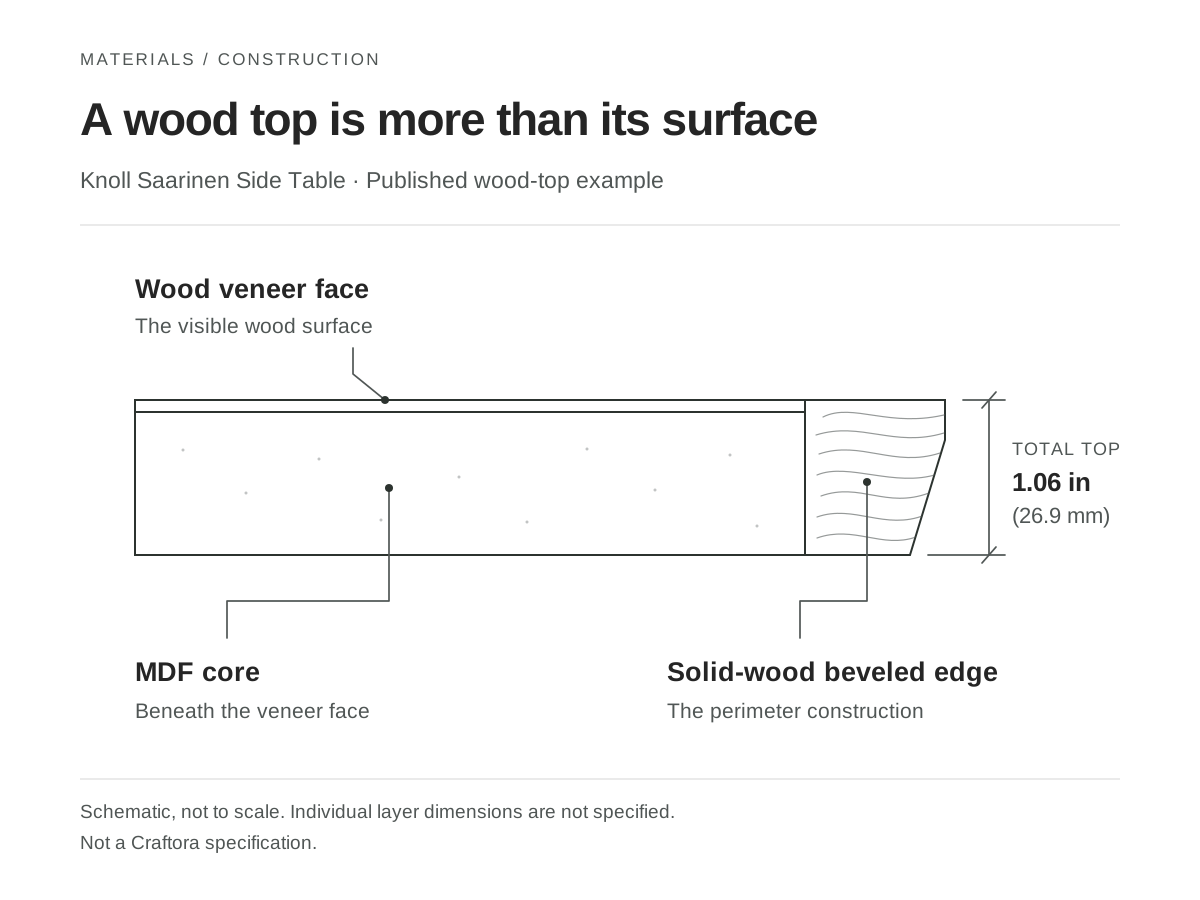
The lesson is how to read a specification, not which brand to copy. A wood surface, engineered core and solid edge can coexist in one design. For your own project, request the same clarity about each component. This independent example does not imply any affiliation between Craftora and Knoll or equivalence between their products.
3. Start with the hotel area and the detail that could fail
Use the room schedule to identify what each surface will face. A wardrobe door, a bedside top and a desk edge do not need to be evaluated in exactly the same way. The following are review priorities, not automatic material recommendations.
Guestroom desks and bedside tops
Discuss the expected contact with luggage, drinks and cleaning products. Review the top, exposed edge, corners and any cable cutouts together. Ask for care instructions and relevant evidence for the proposed finished assembly; a material name alone is not a scratch-, stain- or water-resistance rating.
Headboards, wardrobe fronts and coordinated casegoods
Approve the relationship between adjacent faces. Mark grain direction on the drawing and view a representative group of panels together. Include edge colour and the approved range of natural variation, rather than accepting several isolated samples that look close on a screen.
Exposed rails, shaped details and high-contact edges
Ask for a section drawing or detail sample showing the actual construction. Review joints, profiles and the transition between materials. Decide how a damaged detail would be repaired or replaced before approving the design for repeated rooms.
When a performance report is supplied, check its specimen or product reference, substrate, face, coating, test method, exposure conditions and result. Ask how that specimen matches the proposed furniture. BSI describes BS EN 12720 as an assessment of rigid furniture surfaces’ resistance to cold liquids. Keep that finding tied to its test scope; record separate questions about exposed edges, repeated cleaning and the assembled item’s strength. Ask the project’s technical reviewer which evidence is relevant to the intended use.
4. Keep wood veneer, HPL and MDF separate
A woodgrain appearance does not establish that the surface is wood veneer. Wilsonart describes high-pressure laminate (HPL) as a sheet made using resin-treated kraft and decorative papers. It also distinguishes MDF, a substrate, from HPL, a surface material. Those terms answer different specification questions.
If a supplier proposes a woodgrain HPL alternative, request its manufacturer, product reference, grade and edge detail. Compare its appearance, care instructions and documented suitability for the intended use. Do not silently substitute it for natural veneer, and do not treat every product called “laminate” as the same material.
Craftora's materials and craftsmanship overview describes reviewing veneer, surface finishes and visual matching before production. Use that conversation to identify the proposed build-up and any alternatives while they can still be evaluated.
5. Turn the finish sample into an approval record
A colour swatch answers a narrower question than a finished furniture mockup. Decide what the sample must demonstrate: colour only, an edge and joint, a pair of matching doors, or the complete item. A short, signed material record keeps those approvals connected.
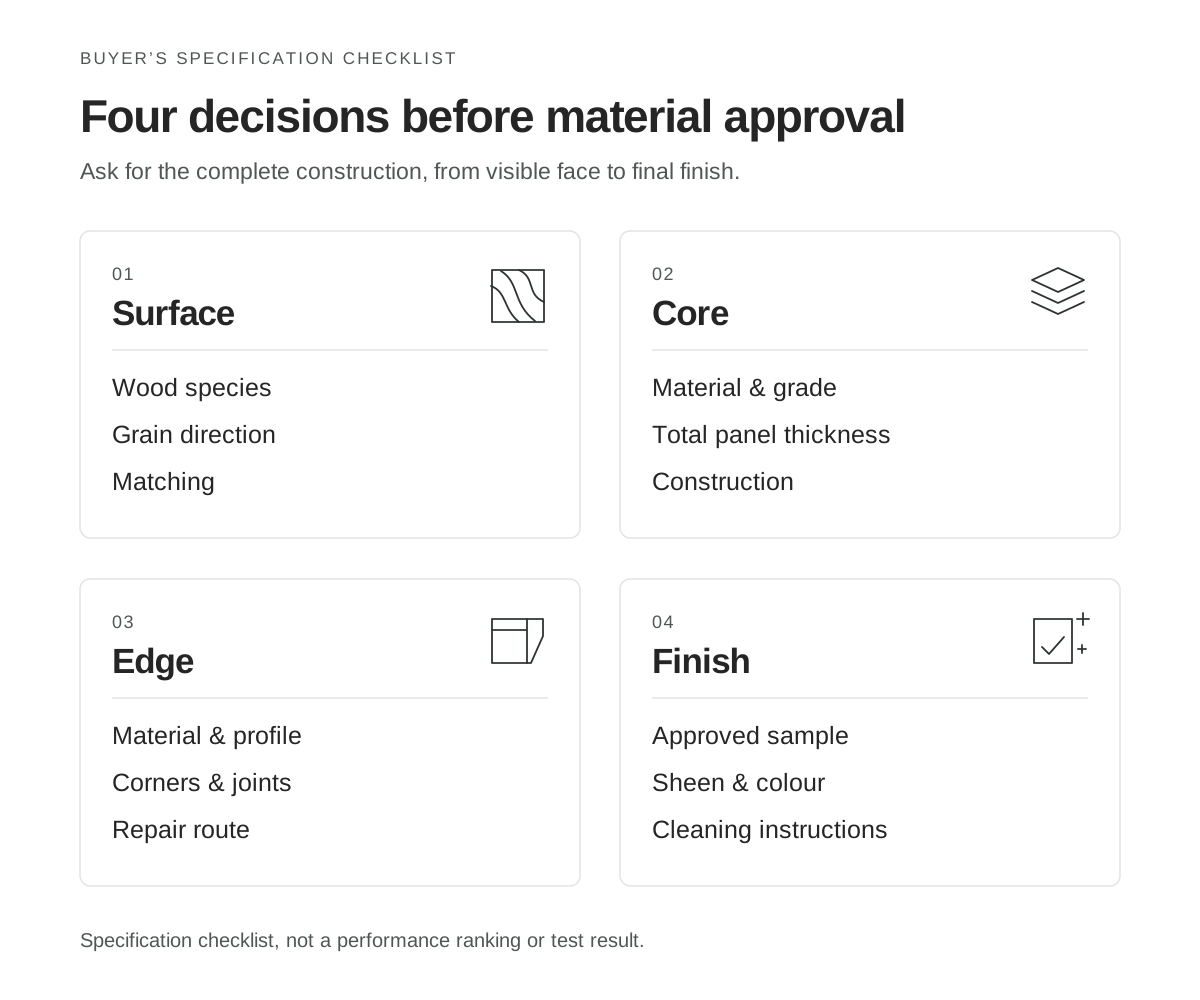
- Identify the item: record the furniture code, component, drawing revision and sample reference.
- Record the build-up: specify the face material, core, overall thickness, edge and finish. Ask the supplier to identify any missing information.
- Define appearance: retain the approved physical reference and note grain direction, matching, sheen and acceptable colour variation.
- Record use and care: identify the proposed cleaning routine and request applicable care, repair and product documentation.
- Control changes: require proposed substitutions to be identified and approved before production, with revised samples where needed.
Check the care and replacement plan
Have housekeeping review the permitted cleaners and periodic maintenance for the proposed finish before approval. Muuto’s published care guidance gives different instructions for lacquered oak veneer and its solid-oak products that require oil treatment. Ask for instructions identifying the actual coating and construction, including any repair limits. Agree which treatments the hotel may use and when the supplier should be consulted.
For repeated-room items, identify a front, top or other component that may need replacement. Record its item code, drawing revision and fixing detail, and ask how it is removed and reordered. Where adjacent veneer faces must match, mark that relationship on the drawing and retain the approved appearance reference for reviewing a future replacement.
For price comparisons, keep the approved specification attached to the quotation. Our small-batch custom furniture quotation guide explains how to align quantities, drawings, inclusions and delivery scope. That is a separate step from deciding whether the material construction is appropriate.
Questions buyers often ask
Is wood veneer real wood?
Yes. Wood veneer is a thin wood layer. The complete item may also contain a manufactured core, solid-wood parts, hardware and finishes. Request the specification for the component you are evaluating.
Is solid wood always better for hotel furniture?
No single label establishes suitability. Compare the design, construction, finish, expected use and maintenance plan. Where natural wood is important to the design, confirm whether that requirement applies to the visible face, the edge or the entire component.
How can I tell whether a tabletop is veneer or solid wood?
Ask for a section drawing and a written specification identifying the face, core, edge and overall thickness. If the build-up is still unclear, request a representative detail sample. The Knoll example above shows why a solid-wood edge does not establish that the whole top is solid timber. Use photographs to discuss appearance, then confirm the construction in the approved drawing and material record.
Which option costs less?
Compare actual quotations for the same design and scope. Species, veneer selection and matching, core, edge work, finish and quantities can all change what is being priced. There is no reliable universal saving percentage to apply to a hotel package.
Review the material direction with Craftora
Prepare a finish board, the relevant furniture drawings and a list of unresolved material questions. Craftora can review the material direction and sample requirements for the project. Ask the team to identify what needs a physical sample, a detail drawing or further confirmation before approval.
