
How to Get a Quote for Small-Batch Custom Furniture
Prepare a small-batch furniture RFQ with item schedules, fabric sourcing responsibilities, supplier review questions and a worksheet for comparing quotation and delivery scope.
In this guide
Need a quote for small-batch custom furniture? Start with an item list, dimensions, quantities by finish and the delivery location. Mark what is fixed and what still needs a decision. You do not have to resolve every detail before the first conversation, but the quote should make its assumptions clear.
Below, you will find a ten-piece schedule example, a quotation comparison worksheet and an RFQ email you can adapt. Use them to give suppliers the same brief and compare what each proposal actually covers.
This guide is for interior designers, contractors and developers sourcing custom furniture for commercial interiors, including hotel lobbies, private clubs and fine-dining restaurants, as well as villas and show flats. These projects often combine several different pieces rather than repeat one standard design across a large order. A clear brief makes it easier to compare proposals without losing the details that matter to the interior.
1. Break the project into designs, finishes and quantities
“Twelve pieces for a lounge” is not a complete production brief. Twelve identical chairs and twelve different designs can involve very different development work, material purchases and setup. Even the same chair in two fabrics may need separate quotation lines.
Start with an item schedule or bill of quantities (BOQ). Keep the same item codes in your drawings, reference images, quote requests and later approval records.
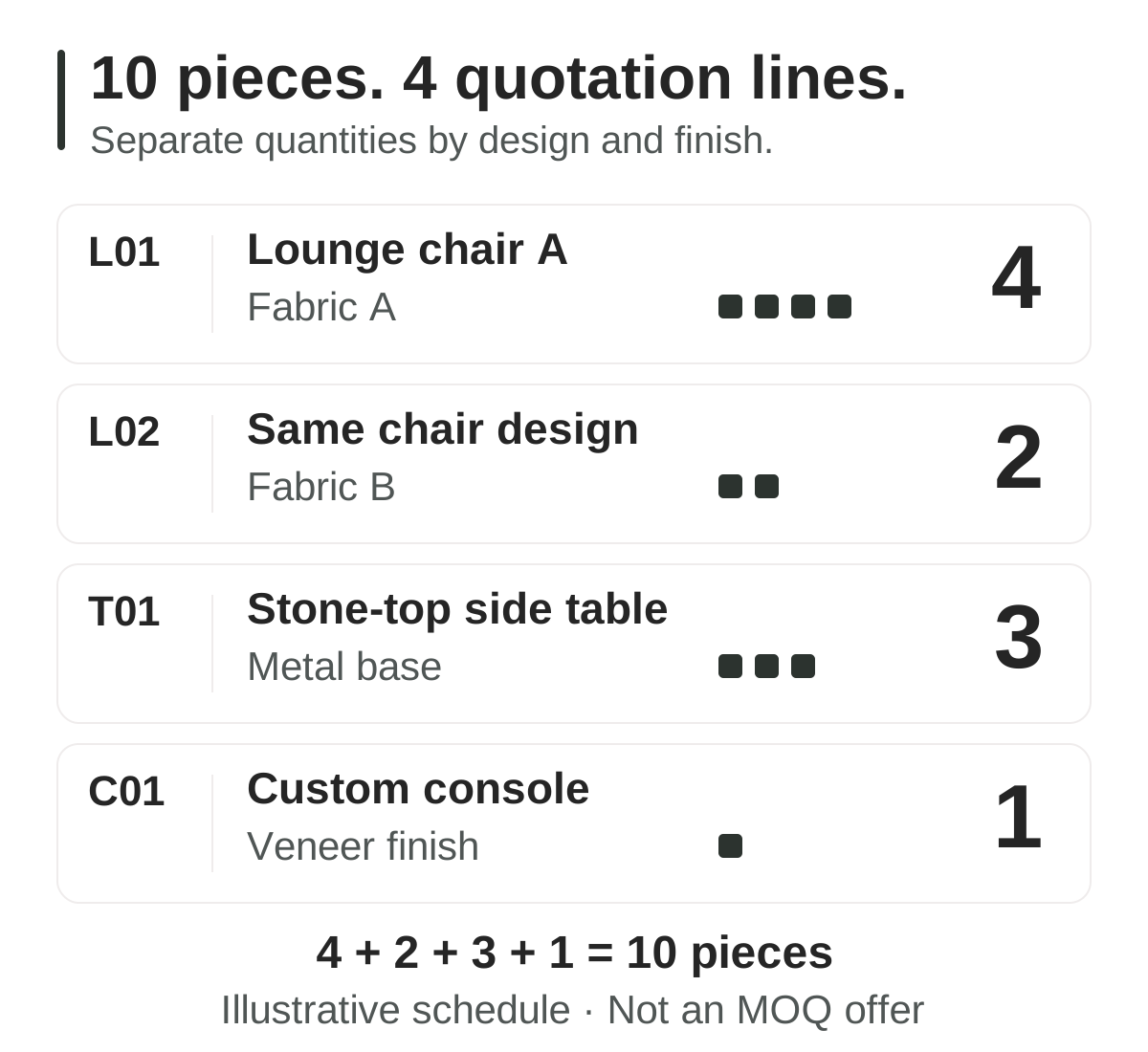
The ten pieces in this example are not ten identical units. Ask whether any minimum quantity applies to each design, each material or finish, or the package as a whole. Do not assume that “custom” automatically means every one-off design is commercially or technically feasible.
2. Make drawings and reference images explain the same design
For custom furniture from drawings, include overall width, depth and height, relevant sections, and dimensions that affect use or fit. For seating, show the intended seat height and depth; for a fitted console or banquette, include the surrounding space and any interfaces with other trades. State the units clearly.
Reference images are useful when technical drawings are not ready. They show visual direction, but they cannot establish hidden construction, exact scale or material specification. Mark them with three simple labels:
- Must keep: the silhouette, a particular arm profile, visible grain direction, or another design-defining detail.
- Can change: a concealed fixing, an alternative material, or another detail you are willing to review.
- Supplier to propose: an unresolved joint, support detail or practical production method.
From inspiration to a usable furniture brief
ArchDaily: connect furniture to the room. The publication's Art Legacy Hotel / Luís Rebelo de Andrade feature describes rooms organized around blue, red, yellow or green, with coordinated wall coverings, furniture and tiles. Use that example to explain your own palette and how furniture should relate to surrounding finishes. Identify the item and detail you want to discuss, then add your own dimensions, material references and annotations. A project photograph communicates an idea; it is not a production drawing.
Muuto: distinguish the configuration from the collection. The official Outline Sofa product page from MillerKnoll lists two-, three- and three-and-a-half-seat configurations alongside overall dimensions. Use this as a checklist for your own design: required footprint, seat height and depth, upholstery and base finish. Mark which decisions are fixed and which need a supplier proposal before treating a reference as a quotation basis.
These are independent design references, not Craftora projects, partnerships or offers to reproduce branded products.
If a rendering and a dimensioned drawing disagree, identify which is current. A file name with the item code, revision and date helps prevent an attractive but outdated reference from becoming the quotation basis.
3. Match the quotation to the project's design stage
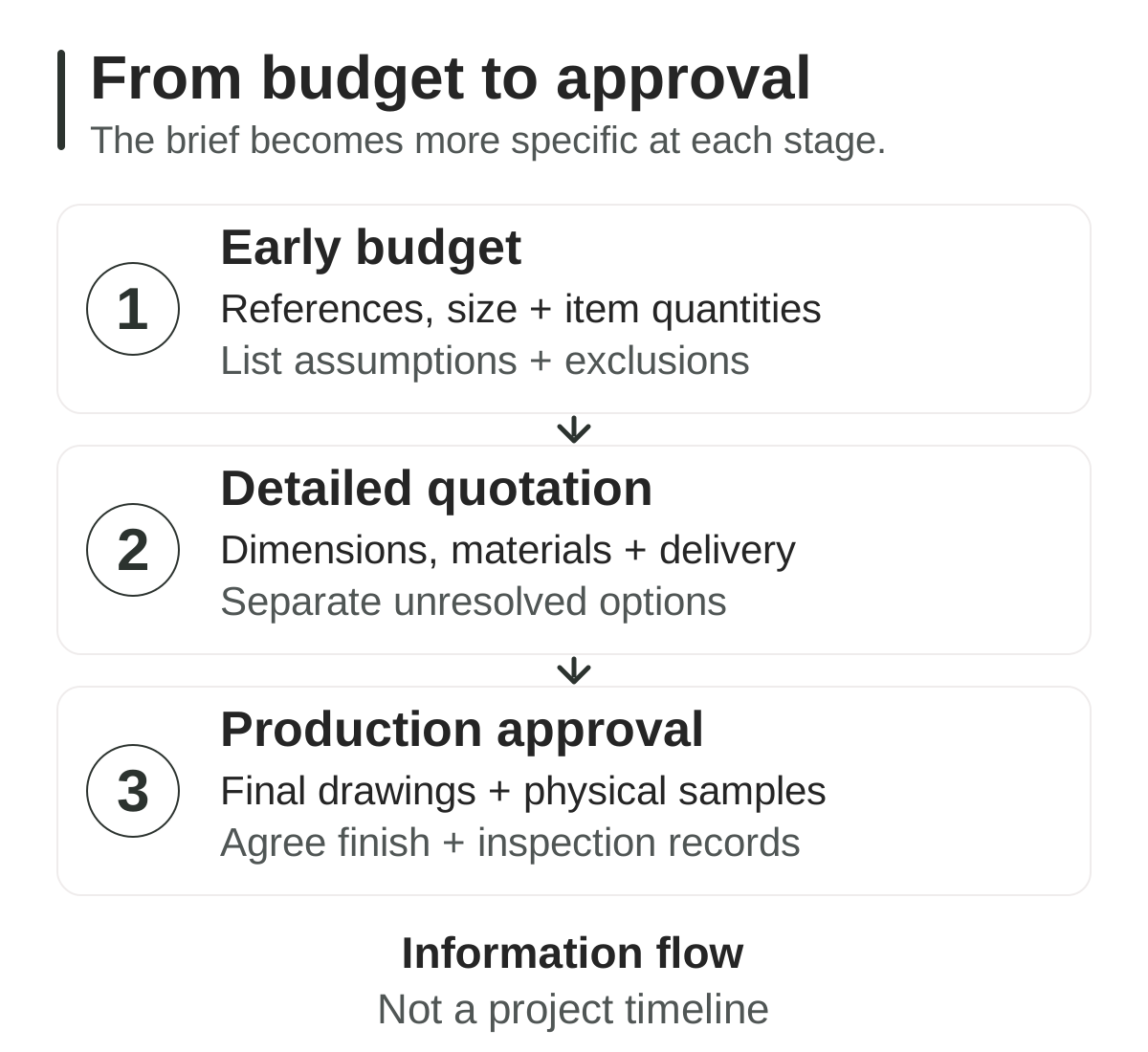
A concept-stage budget and a production-ready quotation answer different questions. Tell suppliers which one you need.
- Early budget: send the intended use, reference images, approximate dimensions, quantities and material direction. Ask for the assumptions and exclusions alongside any estimate.
- Detailed quotation: provide coordinated dimensions, specified materials and finishes, hardware details, packaging needs and the delivery scope. Separate unresolved options instead of hiding them in one total.
- Production approval: agree on final drawings, relevant physical samples, finish references and the records that will govern inspection.
For example, “dark wood with a brass-colored base” may support a first discussion. It does not establish the wood construction, veneer direction, metal finish or approved color standard. A later choice can change both cost and scheduling.
4. Specify materials in a way suppliers can compare
Describe the substrate or frame construction separately from the visible surface. A veneer or lacquer finish does not identify the board or structure underneath it; a stone top also needs its material, thickness and support details clarified. For upholstery, provide a fabric reference or swatch where available, and distinguish the appearance you want from any performance requirements set by the project team.
For wood items, our wood veneer vs solid wood guide helps separate face, core, edge and finish before costing.
For upholstery, record the textile maker, pattern, colour, usable width, repeat and direction. If using customer’s own material (COM), ask who purchases and ships it. Have the supplier confirm suitability and required quantity for the approved design before ordering. Agree where it must arrive and who handles shortages, rejected material and unused fabric.
Where several pieces must look coordinated, say so explicitly. A console, chair frame and table edge can appear close in separate photographs but differ when placed together. Ask how the shared finish reference will be approved and used across the package.
Review the available materials and craftsmanship options before locking the specification. If an alternative is proposed, request it as an identifiable option with its effect on appearance, cost and timing—not as an unexplained substitution.
5. Separate one-time work from the repeat unit price
Small quantities do not necessarily mean simple production. A new curved profile, unusual metal detail or custom finish may require development before the first usable piece is made. Ask whether the following are included, excluded or quoted separately:
- Drawing development, prototypes, sample pieces and any tooling.
- Materials, upholstery, hardware and finish options.
- Unit production prices at the quantities in your item schedule.
- Protective packing, crates where proposed, labels and assembly instructions.
- Transport, delivery, unloading and installation within the agreed scope.
These are quotation questions, not a statement that every supplier charges each item. Ask whether sample costs are separate and whether any credit against a later order applies; do not assume either arrangement.
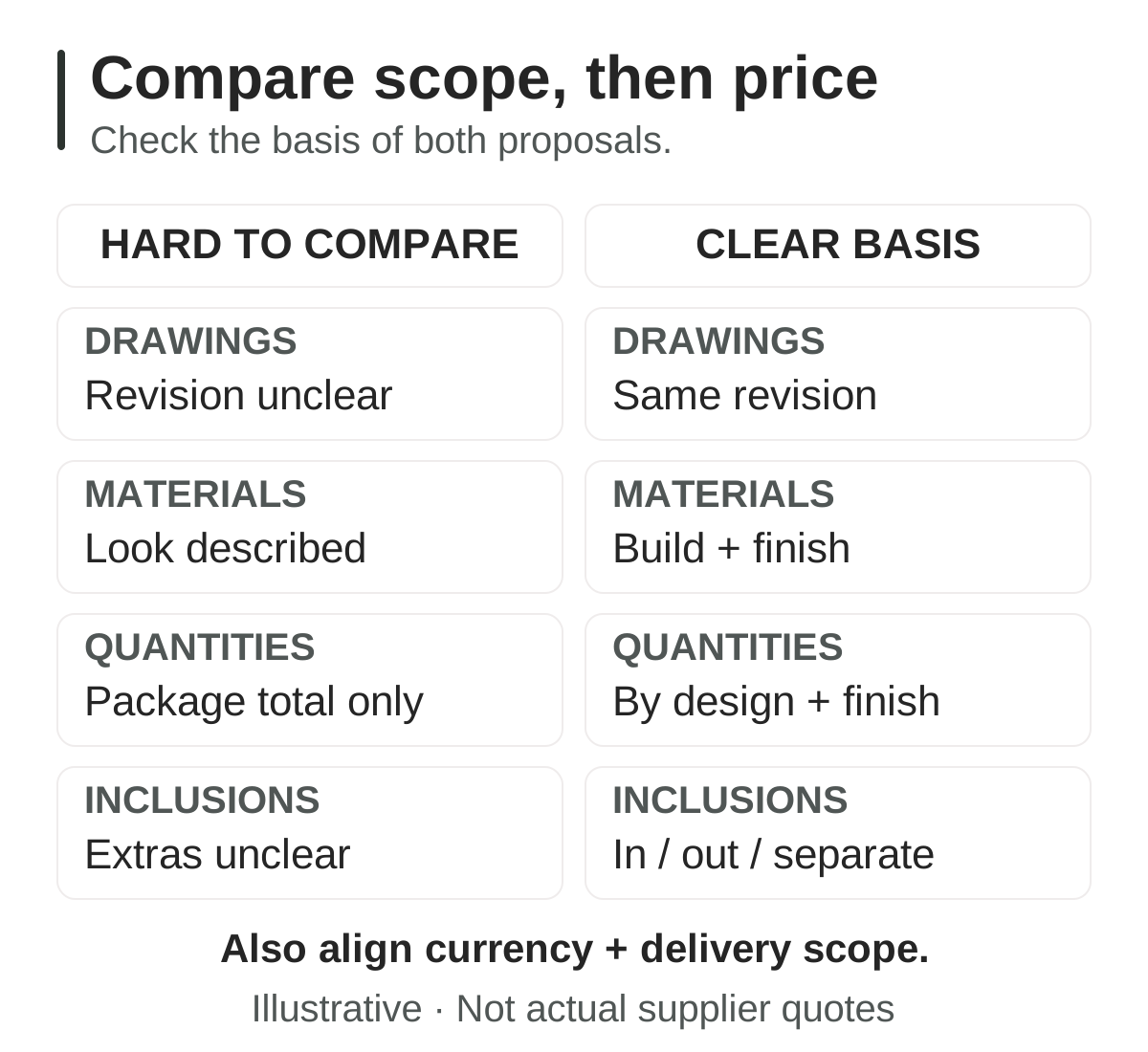
When comparing two proposals, align the drawing revision, materials, quantities, currency, delivery scope and exclusions first. A lower unit price is not directly comparable if it leaves out development, uses a different substrate or stops at a different delivery point.
For an international quote, record the agreed trade term, named place or port, and version where Incoterms are used. Ask who handles freight, insurance, customs formalities, duties, unloading and installation. List separately quoted services and unresolved charges in the comparison sheet. Request clarification if one offer stops at a port and another includes a later receiving point; those totals cover different delivery scopes.
Put unanswered quotation terms side by side
Once the specifications match, check the terms. Use this short worksheet to record each supplier's answer instead of filling in the gaps yourself.
| Question to ask | Quote A | Quote B |
|---|---|---|
| When does the quote expire, and what needs reconfirming? | Record answer | Record answer |
| What are the payment stages and the approvals or deliverables at each stage? | Record answer | Record answer |
| Which drawing revision was priced, and how are later changes approved and repriced? | Record answer | Record answer |
No answer does not mean “included” or “free.” If a clarification changes the scope, ask for a revised written quote and save it with the matching drawing revision.
Review the supplier before commissioning a sample
For a mixed small-batch hotel package, ask how the quoted scope will be managed before commissioning a sample.
- Scope ownership: identify items made directly or through production partners, and who coordinates the complete package.
- Relevant work: request examples or sample records that help you assess the proposed mix of furniture categories and details.
- Approval and inspection: name who signs off drawings and samples, and how discrepancies will be recorded against those references.
- After delivery: ask how defects are reported and which drawing, finish and component records can support later replacements.
Use Craftora’s manufacturing and supply-chain overview to frame the discussion around release, production checkpoints, inspection and export handoff.
6. Confirm sampling, site access and the delivery sequence
Choose what needs physical approval according to the unresolved risk. A finish swatch can help review color and surface appearance, but it cannot demonstrate the comfort or proportions of a new lounge chair. Ask whether a material sample, detail mockup or complete prototype is appropriate, what it costs, and who signs it off.
Give suppliers the required site-arrival window, not only the opening date. Ask which milestones depend on design approval, material availability or sample revisions, and distinguish production completion from delivery to the project.
For oversized or fitted pieces, provide relevant door, lift and access dimensions. Confirm whether delivery is assembled or in sections, who checks site measurements, and who completes installation. In a mixed package, item and area labels also help the receiving team identify where each piece belongs.
Craftora's project workflow describes the stages from file review and sampling through production, quality checks and shipment preparation. Use those stages to agree on the information and approvals needed for your own project.
Know when to budget, clarify or move to a sample
- Use it for budgeting: the design is still open, but the estimate clearly states its assumptions. Keep it marked as provisional.
- Ask a follow-up question: the quote uses an older drawing, leaves a material substitution unidentified, or gives a delivery date without its approval milestones. Clear up that point before comparing prices.
- Agree on the sample step: its purpose, cost, approval criteria and decision-maker are clear. Record what it will prove and what remains open. A finish swatch can settle a color choice; it cannot establish a new chair's comfort.
A short checklist before sending your request
- Project type, destination and a named contact for design decisions.
- Item codes and quantities separated by design, size and finish.
- Drawings or annotated reference images, with current revisions.
- Material references, non-negotiable details and acceptable alternatives.
- Budget direction, if available, and whether you need an estimate or a detailed quote.
- Sample expectations, site constraints and the required arrival window.
- A list of open questions and the delivery services to include.
Incomplete information does not have to stop the first conversation. Make the unknowns visible and ask what must be resolved next. That gives the designer, buyer and supplier a shared basis for evaluating the proposal.
A small-batch RFQ email you can adapt
Use this example to put the brief into one message. Replace the bracketed fields and quantities with your own. The ten-piece schedule is illustrative, not a Craftora minimum-order offer.
Subject: RFQ — [project name] — schedule [revision/date]
We are sourcing furniture for [project type] in [city/country]. We need a [budget estimate/detailed quotation] based on [item schedule] and [drawing or reference files]. Our budget direction, if available, is [amount, currency and scope].
The schedule includes four chairs in fabric A, two chairs in fabric B, three side tables and one console. Please price these four lines separately and flag any design, material or quantity constraints.
- Must keep: [key dimensions, units and design details].
- Material and finish references: [details; fabric supplier and pattern if known].
- Alternatives we can review: [acceptable changes].
- Still undecided: [questions for your proposal].
- Upholstery sourcing to confirm: [supplier-sourced / buyer-supplied / undecided].
Our required site-arrival window is [dates]. Access constraints are [details], and the delivery services we need are [scope].
Please identify assumptions, exclusions and separate development or sample charges. Keep alternatives separate from the specified design, and tell us what information or approvals you need next.
Our design contact is [name]. Please flag missing information before using this brief for a detailed quotation.
Discuss your project with Craftora
Craftora is based in Foshan, China, and provides custom furniture project support, including file review, material coordination, sampling and production planning. For a small-batch commercial interior or villa project, share the information you have so the team can review the scope and clarify feasibility, quantities and quotation requirements.
Contact Craftora about your project with your item list, drawings or reference images, material direction and delivery location. If files are ready, mention them in the inquiry so the team can advise how to share them.
